
Taking off the Sunglasses; or: Metacognitive Therapy

Most of the time, we look at the world through our thoughts. Like a pair of sunglasses, they are a continuous filtering layer, always evaluating and interpreting. But like a pair of sunglasses you’ve had on since birth, like the metaphorical fish that can’t see the water, thoughts tend to “disappear into the world” most of the time. The interpretation appears as real as that which is interpreted.
You don’t question whether the path you feel beneath your feet on the way to work is true, you just feel it and walk accordingly. When looking at the world through our thoughts, they get the same treatment. When a depressed person thinks “I’m a failure”, they feel it and act accordingly. In this mode, thoughts are afforded the same undoubted reality as all other perceptions. Therefore, thoughts are afforded enormous power. There is, however, a fundamentally different way of engaging with one’s internal world.
The Metacognitive Mode
Humans have this curious capability to look at thoughts rather than through them. Something akin to taking off your sunglasses and having a look at the lenses. A part of the world you always thought was pure darkness, as clearly true as the path beneath your feet – maybe it could turn out to be a big speck of dust on the lens? Well, as long as the glasses are on, there is no way to find out.
Let’s try an experiment. In a bit, I’d like you try taking off the glasses. Take a deep breath, close your eyes, and let your mind roam freely. All you have to do is get curious about what’s going on up there, to watch it without making anything happen. Just listen to what your neurons have to say. Alright - give it a shot!
Done? Lovely. You may have found some images come up, a sentence or two, maybe a plan about grocery shopping later, maybe a thought about whether you’re doing it right. Whatever it was, it likely came up, seemingly out of nowhere, and that’s where it went a few moments later.
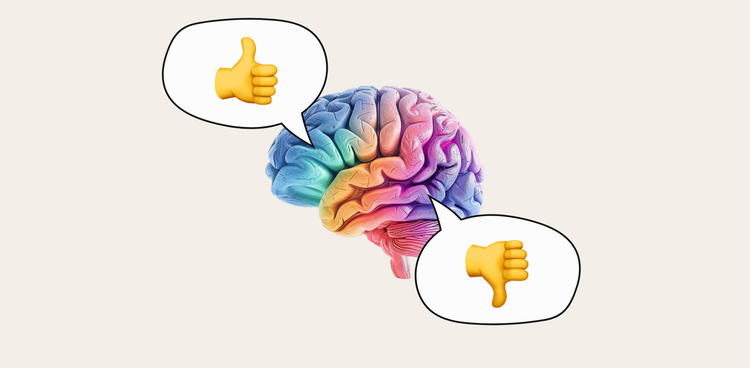
Hanging out here, in the metacognitive mode, where we look at thoughts rather than through them, is the starting point for metacognitive therapy. It’s built on the idea that often, it’s not actually the content of their thinking that’s causing people pain, but the way they relate to their thoughts.
How do we relate to thought?
To see how, let’s colour this in with an example. Here we have three people, let’s call them Andy, Barry and Dean.
On Tuesday morning, they are each making a coffee, spill a bunch, and here comes a thought: "I’m a failure". They’ve thought the same thing - their thought content is identical. But when we now look at the way they relate to that thought, we find their days are going to take very different trajectories.
Barry notices the thought arise. It has a slightly flat, grumpy quality. He furrows his brows in annoyance, but then he remembers to take the glasses off. Barry has been practicing meditation on and off for a few years, and along the way he has watched many thoughts arise and pass away. Some were nice, some were mean, some were ridiculous, all of them seemingly came out of nowhere and that’s where they all disappeared into after a few moments. Over the years, Barry has developed a belief about his thinking process (“metacognitive belief”) that “Thoughts just kinda pop up sometimes - they don’t have to mean too much”. By getting into the habit of looking at his thoughts, Barry has also made some other observations. For example, he noticed that his thoughts tend to be a lot meaner if he’s hungry. He notes to himself “Probably just low blood sugar.”, gets a kitchen wipe, pours himself some cereal, and goes about his day, the thought dissolving like millions before it.
Andy also notices the thought arise, and he is immediately jolted into a state of alarm. He’s been having “bad thoughts” like this more and more, and he’s getting worried he’s losing control. But Andy is also a diligent man, and this feeling of alarm always activates something he learned from his parents : “Worrying means taking my problems seriously. It’s irresponsible to ignore these things…”. When Andy goes into alarm, like he does this morning, there is this feeling that there’s something here, something hidden that he must figure out, so that he can be prepared. “What if I stay like this all day? How will I cope at work?”, he thinks. Before long, he has lost sight of the original thought, and spilt coffee feels like the least of his problems. Andy notices that he’s been spiraling again - more evidence for what he already feared: “My worrying is getting out of control. I can’t stop myself”. And here comes the worry about the worry: “What if I lose my mind?”. Now determined to take control and stop himself from going mad, he tries to suppress his worrisome thoughts - “Think positive”, he says to himself, but when that doesn’t work, he gets even more worried: “Nothing I do helps – I just can’t control it”. Deflated and exhausted, he calls a good friend of his looking for reassurance. A good friend indeed, Barry is happy to tell Andy that he’s a great guy and he doesn’t have to worry so much. And so, Andy finds himself with a bit more peace - but on top of that, more confirmation that he can’t stop his worrying himself.
Dean, on the other hand, isn’t alarmed when he notices the thought. “I’m a failure” sounds so familiar to him. He heard it enough as a kid, and has been looking at himself through this lens for years. It’s not a thought to him, but a simple fact. There’s nothing to challenge here. But while he’s convinced that he is indeed a failure today, there is still a tiny spark of hope that he may not be some day in the future. He’s come to believe that the only way out of this is to analyse – to understand why he is a failure. Why this keeps happening to him, why he is this way, why nothing ever seems to change. And so, Dean bravely spends his morning dwelling, in search of the answers. Sadly, the more he searches, the more evidence he collects. His brain continues to play the greatest hits of his failures. Now, the thought feels truer than ever, and Dean abandons the endeavour of caffeination in favour of returning to his bed. “I can’t even make a coffee”, he thinks before dozing off.
Andy, Barry and Dean all started out with identical thought content, but they ended up in very different places. The difference, metacognitive theory posits therefore, is not any specific thoughts but our relationship to them. Andy isn’t convinced the thought is true, but he’s worried that it might be, that’s reason enough to dive right back into a spiral. Dean is very much aware that this thought is nothing but the truth, and so he finds it important to find out why, only to indeed find all the reasons it might be true. Both are trying their very best to figure out why their world is so dark, and you can really imagine how exhausting that must be. But no matter the effort, their chances are slim if they never take those sunglasses off.
Of course, this is no magic cure. There’s still a lot of work to do once you start inspecting the lenses. What we find: Some thoughts are pretty accurate; others are wildly off. Some are fun, some are plain ridiculous, some are really sad but still kinda true, but whatever the case, they are simply stuff that a brain makes. Some thoughts are genuinely worth challenging; some are genuinely worth letting go. But to make that choice requires the recognition that there’s a choice to be made here. To see whether it’s the world that’s dark, or it’s just your lenses, you gotta take them off every once in a while. And since we are so used to looking through thoughts rather than at them, learning to take them off requires a bit of practice. So, for the curious, here's a collection of experiments (courtesy of Wells, 2008) you can try, and see which one resonates with you:
The Passenger Train
“It is helpful to think of yourself as a passenger waiting for a train. Your mind is like a busy station and your thoughts and feelings are the trains passing through. There is no point in trying to stop and climb aboard a train that is passing by. Just be a bystander and watch your thoughts pass through. There is no point in climbing aboard to be whisked away to the wrong place.”
The Weather
"One way to understand this is to consider experiencing your thoughts as you would experience clouds passing you by in the sky. The clouds are part of the Earth's self-regulating weather system, and it would be impossible and unneessary to try and control them. Try to treat your thoughts and feelings like you would treat passing clouds and allow them to occupy their own space and time in the knowledge that they will eventually pass you by."
The Tiger
Close your eyes and conjure up an image of a tiger. Do not attempt to influence or change the image in any way. Just watch the image and the tiger's behavior. The tiger may move, but don't make it move. It may blink, but don't make it blink. The tiger may wag its tail, but don't make it do that. Watch how the tiger has its own behavior. Do nothing, but simply watch the image, see how the tiger is simply a thought in your mind, that it is separate from you and it has a behavior all of its own."
Who is doing the thinking?
As you do these experiments, consider:
“Are you the thought or the person observing the thought? Try to be aware of your location and what it is like to be the observer. You exist entirely separately from thoughts.”
“Are you the belief or the person observing the belief? Try to be aware of how your consciousness as the observer is separate from your beliefs.”
References:
Wells, A. (2008). Metacognitive Therapy for Anxiety and Depression. United States: Guilford Publications.

Comments ()